One of the first questions homeowners ask is: how much does an architect cost?
It is a fair question, but the answer is not always straightforward. Architectural fees vary based on the size and complexity of the project, the scope of services, and the way a particular firm structures its practice. That last part matters more than many people realize.
Different architecture firms are set up differently. Some focus more heavily on production and documentation, while others put more time and attention into the earlier design phases. Both approaches can produce a set of drawings, but they do not necessarily produce the same quality of project, or the same experience for the client.
At Currant Works, the practice is structured to support a high level of design attention on each project. I work with an international team that supports technical documentation under my supervision, which allows me to stay deeply involved in the design work itself. Because of that structure, fees often fall toward the lower end of the typical range, around 8 to 10 percent, while still allowing for a high level of design attention.
That matters, because the best projects are not just documented well. They are thought through well from the beginning.
Why the Answer Is Not Always Straightforward
When people ask what an architect costs, they are often hoping for a single number. In practice, the better question is usually: what level of service does this project actually need?
A small feasibility study, a major addition, a whole-home transformation, and a new custom home all ask different things of the architect. Even two projects with similar construction budgets may require very different levels of design work, coordination, and construction involvement.
That is one reason architectural fees vary so much. Another is that some of the most valuable work happens before the project is fully defined. Good early thinking can clarify scope, reduce risk, and help prevent time and money from being spent in the wrong direction.
How Architects Typically Charge
Architects usually charge in one of three ways:
- Percentage of construction cost
This is the most common structure for full-service work. A typical range is around 8 to 15 percent, depending on the project. - Hourly
This is often used for consultations, feasibility work, or smaller scopes. - Fixed fee
This can work well when the scope is clearly defined, especially for early planning phases.
Most projects are really some combination of the above.
How Fees Are Usually Divided Across a Project
Architectural services are usually broken into phases:
- Schematic Design — early concepts, layout, and big-picture strategic thinking
- Design Development — refining the design, selecting systems and materials
- Construction Documents — detailed drawings used for permitting and construction
- Permitting and Bidding — approvals and contractor pricing
- Construction Administration — overseeing construction and coordinating decisions in the field
In many firms, a large share of the fee is concentrated in the construction documents phase. In my practice, the fee is somewhat more front-loaded. I put more effort into the early design stages, because that is when the most important decisions are made. If the design thinking is strong from the beginning, the whole project benefits.
Why Additions Are Often More Complex Than People Expect
People sometimes assume that a remodel or addition should be simpler than new construction because it is not starting from scratch. In reality, extensive remodels and additions are often more difficult.
You are working with existing structure, unknown conditions, and the challenge of integrating something new into the logic and character of the existing home. It takes real effort to make that feel cohesive. Because of that, these projects often require more coordination and more design attention than people expect.
That is one reason fees should be understood in relation to complexity, not just square footage.
What This Can Mean in Real Numbers
For a full-service residential project, architectural fees often fall somewhere in the 8 to 15 percent range of construction cost. For example:
- A $500,000 remodel might involve an architectural fee in the range of roughly $40,000 to $75,000
- A $1.5 million project might involve an architectural fee in the range of roughly $120,000 to $225,000
Early feasibility or concept work on its own is typically much less than that, depending on scope.
These numbers are not meant as universal rules. They are simply a way to give some context to a question that is often asked in the abstract.
An Architect Does Not Just Add Value. An Architect Helps Reduce Risk.
Architecture is often thought of as something that adds value. But just as importantly, it reduces risk.
Early in the process, that comes from defining the problem carefully and aligning goals, scope, and budget. Sometimes that means rethinking what should be built. Sometimes it means phasing a project differently. Sometimes it means scaling something back before time and money are spent in the wrong direction. Those early decisions can have a significant impact on the overall cost of a project.
Why Construction Administration Matters
The biggest misconception is that the architect’s role ends with drawings.
It does not.
Construction administration is a critical part of the process. It helps protect the owner by reducing the risk that the project is built incorrectly, built out of code compliance, or built in a way that compromises the design. Earlier in my practice, I made this phase optional. I no longer do.
No set of drawings is perfect, and every project encounters real-world conditions that require interpretation and adjustment. Contractors are making decisions constantly. Without coordination, small decisions can turn into long-term issues.
A few recent examples illustrate the point:
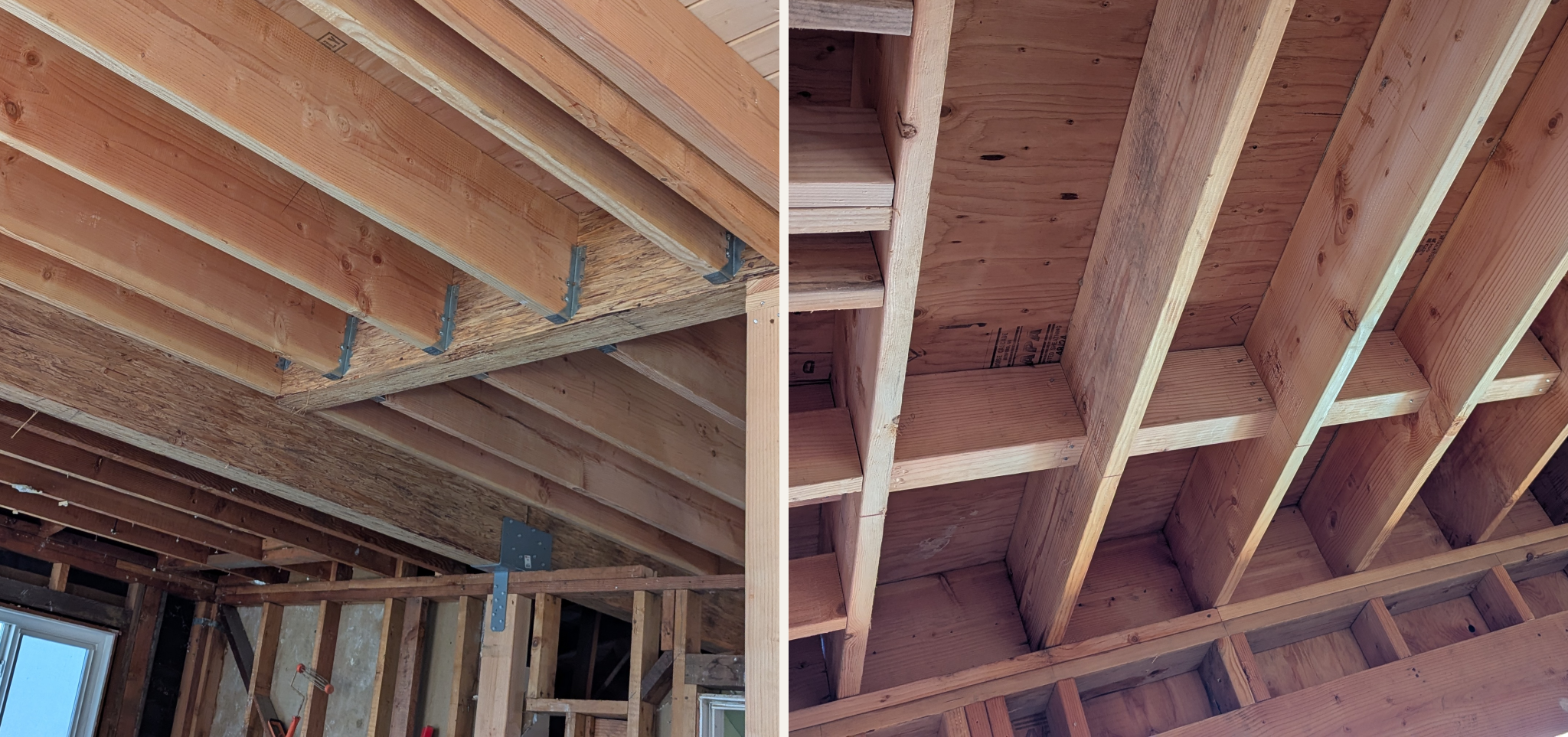
On one project, during a weekly site visit, my job captain noticed incorrectly sized joist hangers and incorrectly spaced joists in a ceiling where additional structural reinforcement was required to support a rooftop hot tub above. Catching it early meant we could coordinate the correct fix with the structural engineer while the framing was still accessible.
On another project, a contractor began to build a roof eave incorrectly, adding conventional birdblocking when the eave was actually designed as a soffited assembly with a continuous fire-protected roof vent. This was a cathedral ceiling condition, so proper venting was critical. Catching it early avoided unnecessary rework and ensured the assembly would vent correctly and meet fire safety requirements.
In another case, a client chose not to retain me during construction in order to save money. The project involved reorganizing walls in an existing home. The contractor built the entry according to plan but ignored an irregular condition in the ceiling framing that had already been flagged by the inspector. Without coordination, the solution became a wingwall that narrowed the entry and disrupted the flow into the living area. That outcome could have been avoided with proper coordination during construction.
The issues that come up in construction are not all the same. They range from structural corrections, to fire safety requirements, to design decisions that affect how the space actually feels and functions. All of them matter, and all of them benefit from having someone looking at the project with the full picture in mind. What ties these examples together is that none of them were obvious until someone with the right perspective was looking at the project at the right moment.
How to Think About Cost the Right Way
A better question than how much does an architect cost might be:
How well is my project being thought through, and who is responsible for that?
You are not just paying for drawings. You are paying for clarity, coordination, and judgment at the moments when decisions matter most — and when they can avoid costly fixes, unnecessary rework, or avoidable compromises to the design.
A residential project is one of the largest investments most homeowners make. Spending a relatively small percentage up front to think it through properly, and to guide it through construction, is almost always less expensive than correcting mistakes later.
If you are considering a remodel, addition, or new home and want to talk through feasibility, scope, and what level of architectural service makes sense for your project, get in touch.