.jpg)
Most homeowners do not begin with a project. They begin with a feeling that something in the house is no longer working as well as it could. A kitchen feels cramped, circulation is awkward, the light is not quite right, or the home simply no longer supports everyday life in the way it once did. Sometimes finishes are worn or tired, and what starts as the idea of a simple surface update becomes an opportunity to address deeper questions about how the space functions and feels.
Why Small Home Improvements Don’t Always Solve the Problem
I also often see homeowners making a series of piecemeal improvements without a larger vision in place. That is understandable. Houses are lived in over time, needs change gradually, and many decisions are made one at a time in response to immediate frustrations. But when those individual fixes are not considered as part of a larger whole, significant money can be spent without fully resolving the underlying issue.
By the time those frustrations become serious enough to act on, one of the first questions is often when to bring in an architect.
Before There Are Drawings, There Are Usually Assumptions
Before there are drawings, there are usually assumptions. Maybe the solution seems obvious at first: add square footage, open a wall, convert a garage, move a bedroom downstairs. Sometimes those instincts are right. Sometimes they are only one of several possible ways to solve the problem.
The reason timing matters is that early assumptions tend to harden quickly. Once a rough scope, budget, or construction approach starts to take shape around an untested idea, it becomes harder to step back and ask whether it is actually the best path.
An architect is not only there to document a solution. At the beginning, the role is often to help define the project clearly enough that good decisions can be made.
A Real Example: Looking Beyond the Poolhouse
I am seeing this now on a project just beginning. The homeowners initially came in with a fairly specific request: their poolhouse is deteriorating and functionally needs to be rebuilt, with a bathroom added for pool access. Over time, it had also become a kind of catch-all space, used as a workshop, bike storage, a very rustic family room, and an office. The structure needs major work, but during the initial walkthrough it became clear that this was not only a poolhouse question.
The main house is also relatively small for a family with two growing children, and the primary suite is particularly tight, with minimal closet space and a cramped bath. The owners are thoughtful and analytical, and they are weighing the project not only in terms of immediate use, but also as a longer-term investment in the home.
Rather than assuming the answer was simply to rebuild what was already there, I suggested that we study a few different approaches. One would focus only on improving the existing poolhouse footprint. Another would explore whether adding usable square footage above could create a more flexible office or guest space. A third would consider whether the project might also help address pressure points in the main house, including the undersized primary suite and the underused area between the two structures.
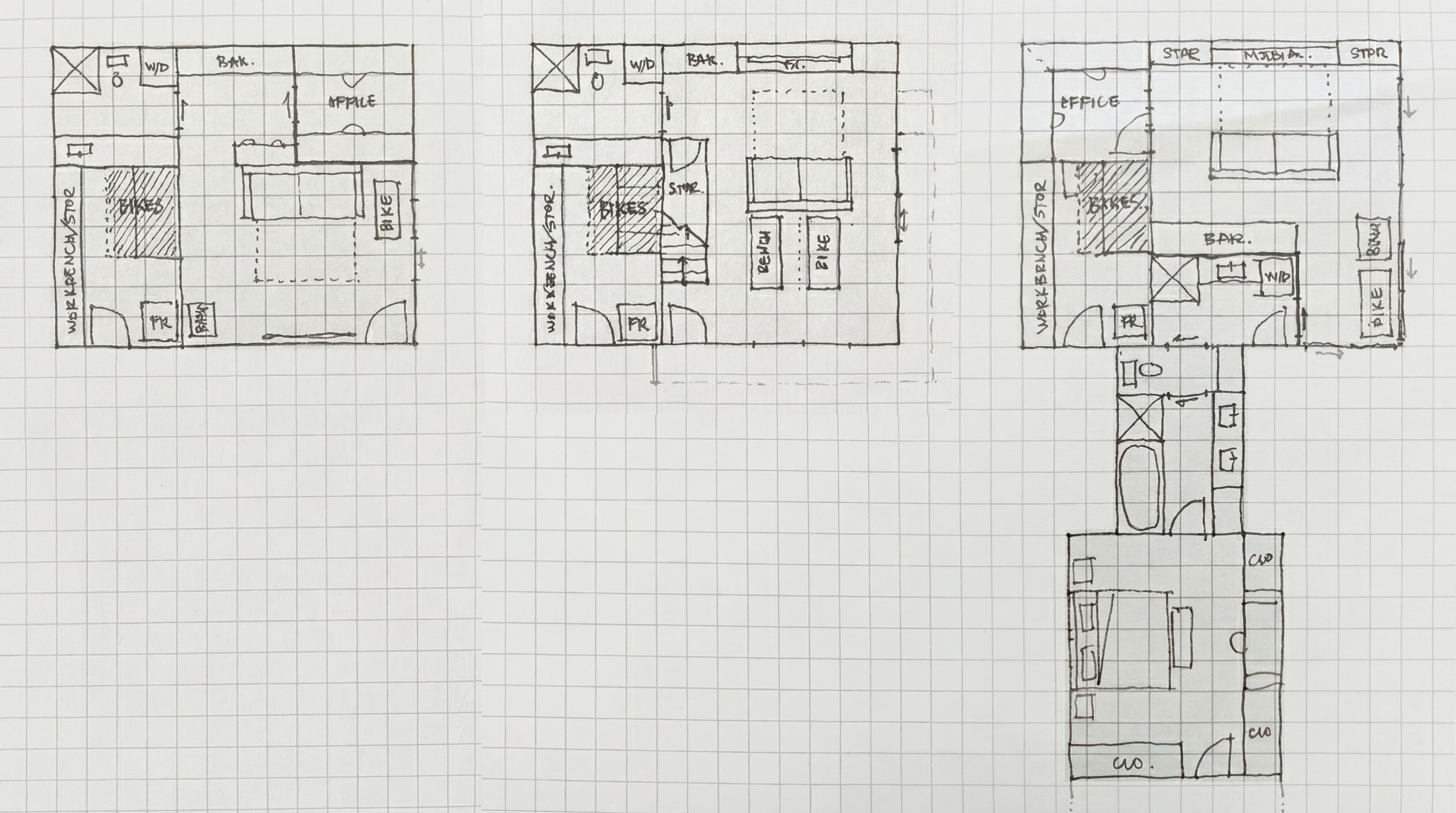
The point was not to make the project bigger for its own sake. It was to understand, early on, whether a limited fix or a more comprehensive approach would make the best use of the investment. That is often the value of bringing an architect in before too much has been decided. At that stage, the work is not just to draw up a solution, but to step back and make sure the project is aimed at the right problem.
You Do Not Need to Have Everything Figured Out
You do not need to arrive with everything figured out. In fact, that is often not the point.
Homeowners come into the process in very different ways. Some have only a general sense that the house is no longer working for them. Others are highly thoughtful and arrive with a clear understanding of what they want to improve. And sometimes people are very smart and well prepared, but still run into the limits of what is easy to predict at the outset. Residential projects involve many interrelated decisions, and not all of the important constraints or opportunities are visible at the beginning.
Bringing in an architect early can help clarify questions like these:
- What is the real problem the project needs to solve?
- Is more square footage actually needed, or would a better reorganization do more?
- What is actually feasible, given the house, the site, and local constraints?
- What will meaningfully improve how the house feels and functions?
- Which ideas are worth pursuing, and which may create more cost or complication than benefit?
This stage is less about locking in answers and more about understanding the range of possibilities. Sometimes the right move is a larger intervention. Sometimes it is a more restrained one. Often the value lies in seeing the tradeoffs clearly before too much momentum builds around a single idea.
That is also why I do not think it is ever really too early to start the conversation.
You do not need to come in with a polished brief or a fully formed project. In many cases, part of the value of involving an architect is precisely in helping to define the problem. Some homeowners arrive with a very clear sense of what they want. Others are still sorting out what is not working, what matters most, or whether the investment they are contemplating is the right one. Both are valid places to begin.
An early conversation does not commit you to a particular scope or solution. It creates space to ask better questions, test assumptions, and think more broadly about what would actually serve you and your home over time. Sometimes that confirms an instinct you already had. Sometimes it reframes the project altogether.
Of course, homeowners reach out at many different stages. Sometimes the project is still just a vague idea. Sometimes there is already a contractor involved, a wish list taking shape, or previous work that has changed the range of options. That does not make the conversation less valuable. It simply means the role may be a little different.
At one stage, the work may be about framing the problem and identifying possibilities. At another, it may be about evaluating decisions already in motion and understanding how to move forward thoughtfully from where things stand. Either way, the goal is the same: to bring clarity to the project and help align the investment with what will matter most in daily life.
When Is It Worth Reaching Out?
Every project is different, but it is usually worth reaching out when any of the following are true:
- You are considering changing the footprint of the house.
- You want to improve flow, circulation, or the relationship between rooms.
- You are trying to bring in more light or create a stronger connection to the yard.
- You are unsure what zoning, permitting, or site constraints may affect the project.
- You are weighing multiple directions and want help understanding which one makes the most sense.
- You care not only about fitting things in, but about how the home will actually feel to live in.
In other words, once the project starts becoming a question of possibility, priority, and fit, not just replacement in kind, architectural thinking becomes useful.
At that stage, the value is often less about arriving at a finished design and more about gaining clarity. It is a chance to identify priorities, test assumptions, and understand what kind of project would actually make sense before too much scope, cost, or expectation builds around a single idea.
For many homeowners, that early clarity is what makes the project begin to feel more manageable.
You do not need to wait until everything is resolved. Often, the most valuable moment to talk with an architect is when the project starts to feel real enough to matter, but is still open enough to be shaped thoughtfully.
That is often where the best work begins.
If you are considering a remodel or addition and want to think through the possibilities before too much is set in motion, feel free to get in touch.